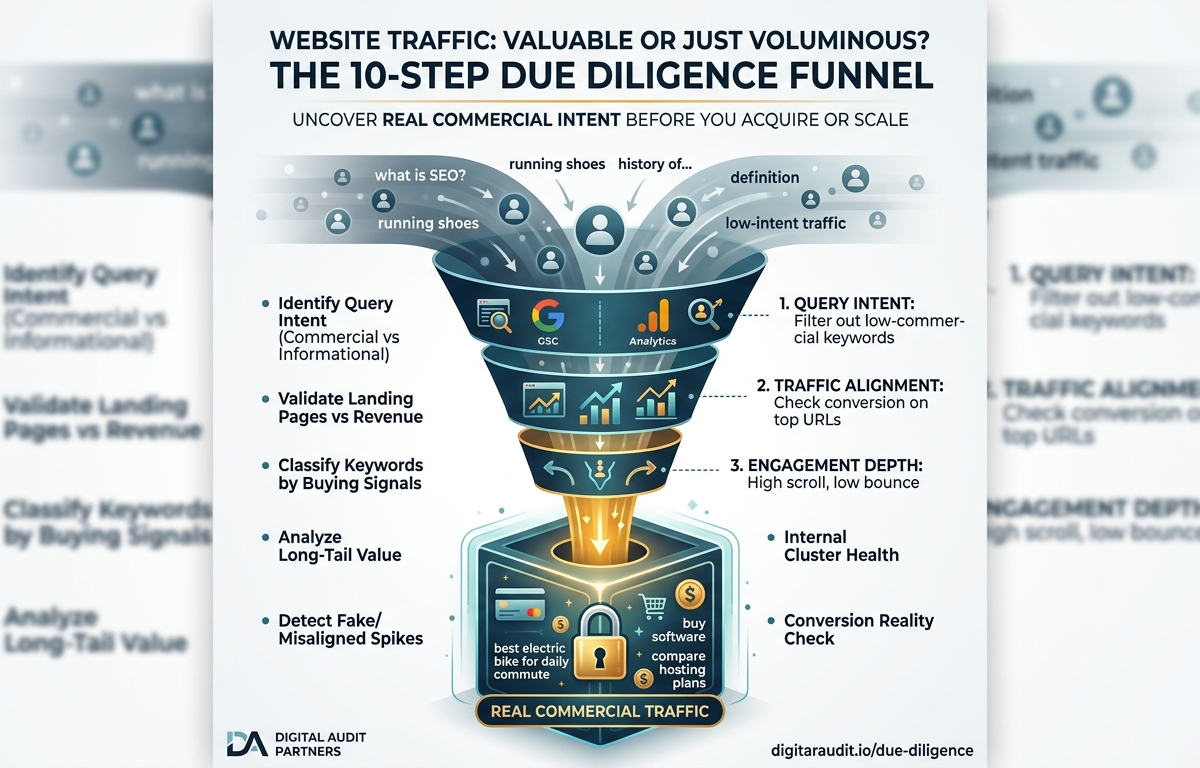
Website Due Diligence: How to Evaluate Real Traffic Intent
1. Identify Whether the Traffic Comes With Intent or Just Volume
Check real queries in Google Search Console Review:
- commercial keywords
- informational keywords with no buying intent
- irrelevant keywords inflating traffic
Key signal: If top queries are “what is…”, “how does… work”, or general definitions, the traffic has low commercial intent.
2. Compare Traffic Pages vs. Revenue‑Generating Pages
Cross GSC + Analytics + monetization data Validate:
- which URLs get clicks
- which URLs generate sales or leads
- whether they match
Example: A site with 80,000 monthly visits but only 2 URLs generating revenue → inflated traffic, weak intent.
3. Classify Keywords by Intent Type
Group keywords into four buckets:
- Commercial: “best X”, “X vs Y”, “X for Y”
- Transactional: “buy X”, “X price”, “discount X”
- Informational: “how to…”, “what is…”
- Navigational: brand searches
Professional insight: Sites dominated by informational keywords often have high traffic but low revenue.
4. Check Whether Traffic Lands on Intent‑Driven Pages
Analyze the top 20 URLs by traffic Classify each URL as:
- commercial
- informational
- mixed intent
Critical signal: If most traffic lands on informational content, the business is not stable for affiliate or ecommerce monetization.
5. Detect Artificial or Misaligned Traffic
Red flags for low‑intent or fake traffic:
- sudden unexplained spikes
- traffic from non‑buyer countries
- keywords unrelated to the niche
- old URLs receiving irrelevant traffic
Example: A “running shoes” site receiving traffic for “shoe history timeline” → useless for monetization.
6. Evaluate Engagement Depth as a Proxy for Intent
Key metrics:
- time on page
- scroll depth
- pages per session
- internal link clicks
Interpretation:
- high engagement → real intent
- low engagement → accidental or low‑quality traffic
Tip: Commercial pages typically show lower bounce rates and deeper scroll.
7. Validate High‑Value Long‑Tail Keywords
Look for long‑tails with clear buying signals:
- “best X for Y”
- “X vs Y for Z”
- “X reviews”
- “X problems and solutions”
Insight: Commercial long‑tails are the most stable revenue drivers after acquisition.
8. Check Keyword and Cluster Dependency
Risks:
- dependence on 1–2 main keywords
- dependence on a single article
- weak or incomplete clusters
Example: A site relying on “best electric bike” is extremely vulnerable to updates.
9. Analyze the Internal Structure Supporting Intent
Review:
- topic hubs
- clusters
- contextual internal links
- click depth
- authority flow
Positive signal: A well‑built cluster indicates intentional SEO and stable long‑tail performance.
10. Confirm Whether Traffic Actually Converts
Cross‑check:
- organic clicks
- affiliate link clicks
- real conversions
Critical insight: High traffic + low conversions = misaligned intent or poor monetization structure.
Summary Table: Evaluating Real Traffic Intent
| Area | What to Review | Signals of Real Intent |
|---|---|---|
| Queries | Commercial & transactional keywords | “best X”, “X vs Y”, “buy X” |
| URLs | Pages receiving traffic | Match revenue‑generating URLs |
| Engagement | Time, scroll, internal clicks | Deep sessions, low bounce |
| Monetization | Conversions per URL | Commercial long‑tails convert |
| Structure | Hubs, clusters, internal links | Strong linking to money pages |