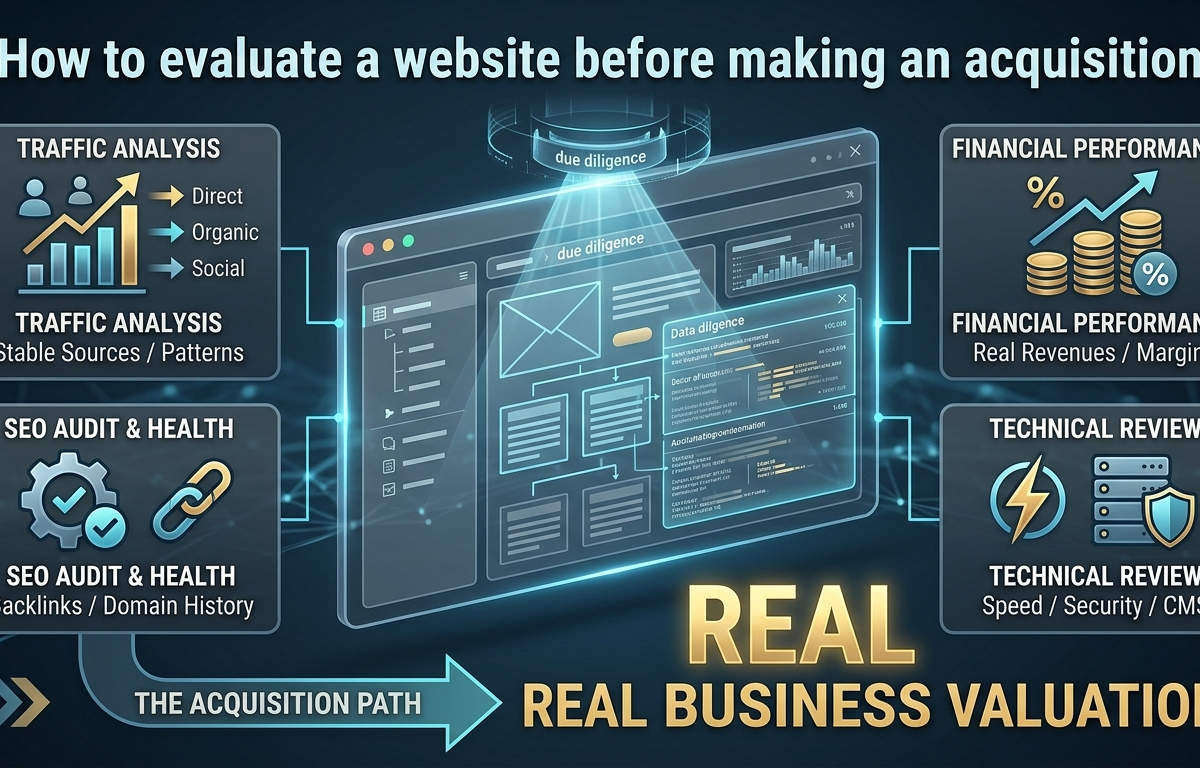
How to Evaluate a Website Before Making an Acquisition
Evaluating a website before buying it requires reviewing the fundamentals that determine whether the asset is stable, profitable, and transferable. Google always shows the same pillars: traffic, financials, SEO, technical, content, legal, and growth. Here is the reduced version that prepares the reader without exhausting them before your differential part.
1. Traffic Analysis
Evaluating traffic means understanding where users come from, whether the sources are stable, and if the patterns make sense. A site that depends on a single channel is more fragile than a diversified one. It is also key to check for sudden spikes or drops that do not align with the natural evolution of the project. Traffic stability is the first indicator of whether the business can sustain itself after the purchase.
2. Financial Performance
Reviewing financials involves confirming that revenues are real, consistent, and backed by verifiable data. The numbers must follow a coherent logic with traffic and user intent. It is also important to analyze trends, seasonality, and margins to understand if the business can maintain its performance. If the data does not fit, the risk of overpayment increases.

3. SEO Audit
A basic SEO audit allows for evaluating the long-term health of the site. This includes reviewing backlinks, domain history, rankings, and potential technical issues. A clean profile indicates stability, while toxic links or past penalties can compromise the project’s future. SEO health determines whether traffic can be maintained after the acquisition.
4. Technical Review
Technical analysis reveals if the site is well-built and if it can scale without issues. Factors such as speed, hosting, security, and CMS structure directly influence user experience and SEO performance. A technically weak site may require unexpected investments after the purchase. Technical soundness reduces operational risks.
5. Content & UX Quality
The quality of content and user experience determines how visitors interact with the site. Outdated, duplicate, or poorly structured content affects both SEO and conversion. Good UX facilitates navigation and improves overall performance. This analysis helps understand if the site is aligned with modern user expectations.
6. Legal & Ownership Verification
Legal verification ensures that all site assets can be transferred without issues. This includes the domain, brand, contracts, provider accounts, and any protected elements. A business may seem solid, but if ownership is not clear, the acquisition becomes risky. Legal clarity protects the buyer from future conflicts.
7. Growth Potential
Growth potential determines if the site can increase its value after the purchase. This includes content opportunities, new keywords, conversion improvements, and monetization expansion. A site with room for growth is a more strategic investment than a stagnant one. This analysis completes the general overview of the asset.
Additional due diligence points required
In addition to the main pillars—traffic, financials, and SEO—there are other factors that experienced buyers review before acquiring a website. These elements do not always appear in Google summaries, but they do appear in expert articles and actual due diligence practices. Here are the additional points that complete the evaluation.
1. Competitor Analysis
Analyzing the competition allows for understanding if the site has a defensible position in its niche. A saturated market or one dominated by large brands can limit future growth. It is also important to evaluate if the site’s content provides something unique or if it is easily replicable. Competition defines the level of risk and the potential for expansion.
2. Monetization Breakdown
Monetization must be reviewed beyond total revenue. It is key to understand if the site depends on a single affiliate program, a single advertiser, or a model vulnerable to external changes. A business with multiple revenue sources is more stable than one based on just one. Diversification reduces the risk of sudden drops.
3. Owner Dependency
Many sites rely excessively on the current owner, whether due to their content style, relationships with suppliers, or social media presence. If the business functions thanks to personal skills that are difficult to replicate, the transition can be complicated. A site with documented processes and delegable tasks is easier to operate after the purchase.
4. Traffic Quality
Traffic quality matters as much as volume. Metrics such as time on page, pages per session, and bounce rate reveal if users truly find value. A site with high traffic but low interaction may have intent or relevance issues. Traffic quality determines the stability of the business.
5. Conversion Rate & Funnel Review
Reviewing conversion helps to understand if the site converts by design or by chance. A clear funnel, with defined and optimized steps, indicates a mature business. In contrast, inconsistent conversions can signal UX or intent problems. Conversion is the bridge between traffic and revenue.
6. Email List & CRM Assets
A solid email list is a valuable asset that many buyers overlook. It is not just the size that matters, but the quality, segmentation, and open rates. An active list can generate recurring income and reduce dependence on organic traffic. It is also important to confirm that the list transfers with the sale.
7. Social Media & Brand Presence
Social media presence can be an asset or an illusion. A classic example: a YouTube channel with 1 million subscribers but only 10,000 views per video. This indicates a disconnected or artificial audience. What matters is not the number, but the relationship between followers and real engagement.
8. Supplier & Partner Risk
In eCommerce businesses, supplier stability is critical. A site may have good margins but depend on a single supplier without a formal contract. Changes in prices, delivery times, or availability can affect profitability. The strength of the supply chain is an essential part of due diligence.
9. Customer Reviews & Reputation
The site’s reputation reveals how users perceive it. Negative reviews, recurring complaints, or poor customer service can indicate structural problems. A business with a good reputation is more likely to maintain its performance. User perception is a leading indicator of stability.
10. Migration & Transition Complexity
Site migration can be more complex than it seems. Factors such as hosting, integrations, plugins, or custom configurations can generate problems during the transition. A site that is easy to migrate reduces technical risks and accelerates the launch. Technical complexity must be evaluated before buying.
11. Red Flags
There are signals that indicate immediate risk: bought traffic, inflated income, duplicate content, or hidden penalties. These red flags usually appear when the numbers do not fit the market reality. Identifying them in time avoids problematic purchases. Due diligence must be capable of detecting them.
12. Valuation Multiples
Valuation multiples help determine if the price is fair. Comparing the site with similar market sales allows for understanding if the seller is asking for more than is reasonable. A multiple that is too high can indicate unrealistic expectations. Valuation must be based on data, not emotions.
13. Workload Estimation
The real workload of the site is key to knowing if you will be able to operate it. Some businesses require only a few hours a week, while others need daily attention. Evaluating tasks, processes, and responsibilities helps avoid surprises. The time required must fit your capabilities.
14. Tools & Access Required
Due diligence requires access to tools such as Google Analytics, Search Console, affiliate dashboards, or eCommerce platforms. Without this access, it is not possible to verify the data. Confirming that the seller provides it is an essential part of the process. Transparency is an indicator of trust.
15. Historical Trends
Reviewing the site’s historical trends allows for understanding its evolution. A business that grows steadily is more stable than one with sudden peaks. It is also important to analyze the impact of Google updates or market changes. Trends reveal the true health of the project.

Business model continuity (the point almost no one evaluates)
There is a critical element that does not appear on Google, does not appear in page 1 posts, and yet, it is the one that determines whether an acquisition works or sinks in the first 90 days: the operational continuity of the business model. It does not depend on the asset. It depends on the buyer.
The real question is not whether the site works today. The question is: can you keep it working tomorrow?
A business can have stable traffic, verified income, and impeccable SEO, but if the buyer does not have the team, the skills, or the operational capacity to sustain it, performance plummets. And when a business falls in the first three months, it is almost never the fault of the asset: it is the fault of the transition.
Operational stability is essential in that period. Not to grow. Not to optimize. Only to not break what already works.
If the model requires daily content, do you have someone to produce it? If it depends on relationships with suppliers, can you maintain them? If the current owner performs invisible tasks, are they documented? If the business works because of their intuition, can you replicate it?
Continuity is not an «extra.» It is the true filter between a profitable purchase and a silent disaster.
Average profit: the metric that reveals the business truth
One of the most common errors when evaluating a website is assuming that the annual profit is a stable reference. It is not. In most niches —and especially in content + affiliation— conversions are not uniform throughout the year. The market changes, prices change, commissions change, and user intent changes. Therefore, the real average profit is not calculated using 12 months: it is calculated using the last 4–5 months, which reflect the current state of the market.
To understand this, let’s use a simple example: a content + affiliation website about electric bikes.
It is a niche with seasonality, demand spikes, price changes, and strong variations in purchasing intent.
Realistic example: electric bike website (content + affiliation)
Suppose the website monetizes with Amazon + 2 private affiliate programs.
Traffic is stable, but conversions vary according to:
- climate
- new model launches
- stock availability
- changes in commissions
- demand spikes (spring/summer)
Here is a table with realistic values:
Monthly profit (last 12 months)
(realistic example for an electric bike website)
| Month | Income | Expenses | Profit | Notes |
| January | 1.800€ | 300€ | 1.500€ | Cold month, low intent |
| February | 2.000€ | 300€ | 1.700€ | Slight increase |
| March | 3.200€ | 350€ | 2.850€ | Start of season |
| April | 4.500€ | 350€ | 4.150€ | High intent |
| May | 5.200€ | 350€ | 4.850€ | Demand peak |
| June | 4.900€ | 350€ | 4.550€ | High stability |
| July | 4.300€ | 350€ | 3.950€ | Strong summer |
| August | 3.800€ | 350€ | 3.450€ | Slight drop |
| September | 3.000€ | 350€ | 2.650€ | End of season |
| October | 2.400€ | 300€ | 2.100€ | Colder market |
| November | 3.600€ | 300€ | 3.300€ | Black Friday |
| December | 2.200€ | 300€ | 1.900€ | Gifts, but low real intent |
Why 12 months are NOT used
If you calculate the annual average profit:
- Total profit: 36.000€
- Average monthly profit: 3.000€
But this number does not represent the current reality.
The electric bike market changes every 3–6 months:
- new models
- price changes
- commission changes
- intent changes
- stock changes
- seasonal traffic changes
Using 12 months is mixing the old market with the current market.
Why only 4–5 months are used
Let’s look at the last 5 months from the example:
| Month | Profit |
| August | 3.450€ |
| September | 2.650€ |
| October | 2.100€ |
| November | 3.300€ |
| December | 1.900€ |
Real average profit (last 5 months): 2.680€
This number does reflect:
- the current market
- the current intent
- the current commissions
- the current competition
- the current demand
And it is the number that should be used to value the business.
Operational conclusion
Average profit is not a photo of the past:
it is a reading of the present.
Therefore:
- 12 months = noise
- 4–5 months = reality
And in an acquisition, reality is the only thing that matters.